Grave of the Fireflies, Animated/ Drama, 1988
By Samantha McKinney
Plot: A boy and his young sister try to survive in wartime Japan.
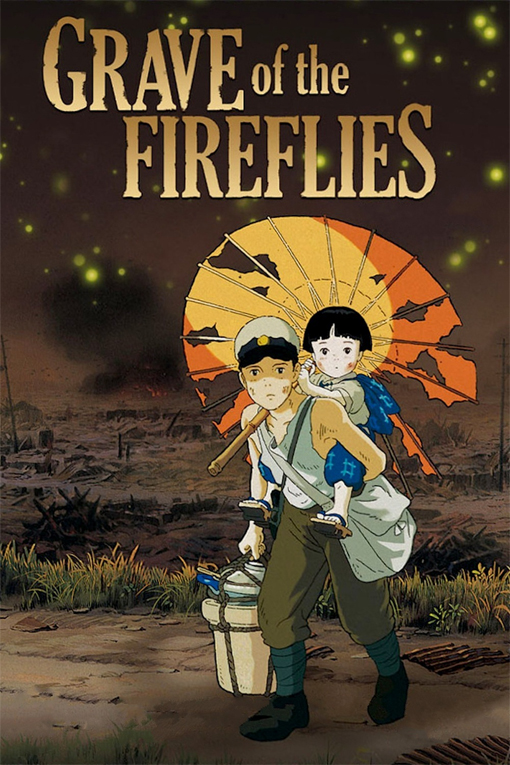
Thoughts: A mournful film detailing the devastation of war and the lives it touches, Grave of the Fireflies is undoubtedly a departure from the typical “cartoon” aura associated with animation. The aching tone this film employs speaks to the grit and realism of war, and as the viewer hopes there will be some sort of reconciliation or consolation for the characters, it never comes. The film begins with the death of Seita, a boy in WWII era Japan. We are then navigated through the film by Seita’s ghost, who unfolds the tale through his ethereal presence as he re- watches meaningful events unfold in his short life. At the start of his flash back, air raids claim the life of Seita’s mother, leaving Seita and his young sister Setsuko to fend for themselves in a country ravaged by war. Seita’s father’s fate remains nebulous throughout the film, as he is an officer on a Japanese naval ship far from home. Without parental guidance the burden of responsibly is placed on young Seita, still a child himself. He must find food and shelter for himself and Setsuko in a time where few are willing to help and there is not enough to go around. This anime paints the grim realities of war and is a powerful testament to it’s unforgiving nature.
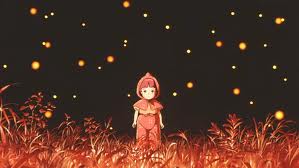 The poignancy of this story lies in its sense of finality. From the start, we know the characters will die slow and painful deaths; our knowledge of this inevitability however does nothing to diminish the ache one feels for the young family. The slow pace of the film mirrors the hardships of war and the struggle to survive, and as Seita and Setsuko eventually succumb to malnourishment and starvation the viewer sees in war there is often no light at the end of the tunnel. The film chronicles Seita doing what he must to ensure the survival of himself and his sister through his descent into thievery and desperation. The only emotional reprieve in the film is the fireflies in the abandoned building the two inhabit; the bugs provide relief for Setsuko’s fear of the dark and cast a fanciful glow around their grim surroundings. The firefly symbolism is amazing, as the bugs burn brightly then quickly burn out – much like Seita and Setsuko’s short time on earth.
 When it becomes evident Seita cannot save his sister, his will and purpose are destroyed. Setsuko’s final push for life proves futile as she grows too weak to consume what little food is available, and we observe starvation come for her much as Seita does; we can only watch. After Setsuko’s burial, Seita’s life is a blur. He eventually arrives at a train station where he is too weak to press on, and alone and penniless he dies murmuring his sister’s name to callous passersby. This lack of concern for one’s fellow man is a central theme in the film, as Seita is cast aside over and over again by those that could extend a hand; the aunt he lives with briefly after his mother’s death, the farmer who reprimands and assaults him for stealing crops, the blazé doctor who casually suggests Setsuko needs nourishment as he calls the next patient. No one cares for the young pair, whose fate could have been avoided through human compassion. The anti-war feel of the film is fueled by this coldness Seita and his sister encounter, as the war surfaces everyone’s worst self.
The moments the film captures through the eyes of Seita’s ghost are both touching and powerful, as we derive an inkling of his sense of guilt and shame. His life’s tragedy is that he could not protect his sister, and as we watch Seita relive his life’s events the film is deepened. Even when he meets Setsuko in death the feeling is hollow – it’s not a joyous reunion but more so speaks to the familiarity the two developed. As they each dominated each other’s landscapes in life, so in death. This again evidences the bitter reality of war; no part of the film is upbeat or hopeful, and even the character’s deaths do not bring them absolute peace.
Though the tone of this film is far more sever, Studio Ghibli films often seem to have a message relating to times gone by and the devastation of war. Howl’s Moving Castle and Porco Russo both feature warfare, and Pom Poko and Princess Mononoke center on old traditions bulldozed by modernity. This film however is set apart by its patience, deliberateness and utter realism – it contains no fanciful elements or creatures like the others. Overall I highly recommend seeing this movie, though it is something you likely only want to view once. I also advise against showing it to young children, despite the medium. Seita and Setsuko’s tale is undoubtedly one altogether uncommon, and the film pays tribute to those lost in the folds of war.
Why must fireflies die so young?
Rating: 4.5/5
 The Film Chronicles